

One of the most common things heard in the coin and precious metal business is this:
“These old coins probably aren’t worth much.”
And honestly… sometimes that’s true.
But sometimes somebody walks in carrying a dusty cigar box from the back of a closet that turns out to contain coins quietly sitting there worth far more than anybody realized for the past 40 years.
That’s part of what makes coin collecting interesting. Value is not always obvious at first glance.
A lot of people assume coin collections are evaluated strictly by silver or gold weight. They think the process basically involves tossing coins on a scale like somebody measuring shrimp at a seafood market.
But evaluating coins is usually much more complicated than that.
Metal content matters, of course. Gold and silver prices influence many collections significantly. Older coins often contain precious metals that modern coins no longer use in the same amounts.
But collectors and buyers also look at rarity, condition, mint marks, historical significance, collector demand, and authenticity.
And sometimes the coin that looks the least impressive turns out to be the most valuable one in the group.
That surprises people constantly.
One of the first things looked at during an evaluation is the type of coins involved. Some collections contain mostly bullion pieces meant for precious metal investment. Others contain historical coins, proof sets, commemoratives, foreign currency, or coins collected over generations.
Every collection tells a slightly different story.
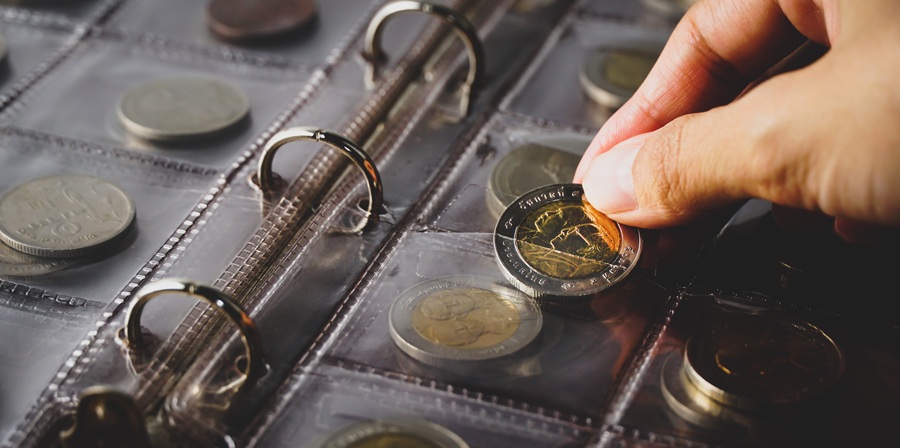
Some people organize coins carefully in albums with handwritten labels and magnifying glasses nearby like museum curators.
Others store them in coffee cans, Crown Royal bags, tackle boxes, or old kitchen drawers beside expired batteries and mystery keys nobody remembers anymore.
And yes… sometimes valuable coins really do show up in old mayonnaise jars.
Condition plays a huge role too.
Two coins from the exact same year can have dramatically different values depending on wear and preservation. Scratches, cleaning marks, dents, discoloration, and surface damage all affect collector interest.
That’s why coin collectors become extremely nervous when somebody says, “I polished all these old silver dollars to make them shiny.”
For many collectible coins, cleaning actually lowers value.
And not by a little.
A naturally aged coin with original surfaces is often preferred over a heavily polished coin that looks like it lost a fight with a Brillo pad.
People mean well, but collectors usually want originality, not sparkle.
Another important factor is mint marks. Tiny little letters on coins can make enormous differences in value.
A coin minted in one location may be fairly common while the same coin from another mint becomes much rarer.
That’s why experienced buyers examine coins carefully instead of assuming everything is valued strictly by metal weight.
Then there’s rarity itself.
Some coins were produced in limited quantities. Others became rare because many were lost, melted down, or heavily circulated over time. Historical events also influence collectibility.
Coins connected to certain time periods often attract strong collector interest simply because of the history attached to them.
There’s something fascinating about holding a coin that circulated during the Civil War, the Great Depression, or the early days of American expansion. Coins are tiny pieces of history people can physically hold in their hands.
And unlike most modern technology, they still work even without a software update.
One thing people often overlook is authentication.
Counterfeit coins exist everywhere now, especially online. Some are obvious. Others are extremely convincing. Weight, size, edge details, magnetic properties, and metal composition all get examined during evaluations.
Sometimes advanced tools are used.
Sometimes experience alone catches something unusual immediately.
After enough years around coins, small details start standing out automatically.
One thing always recommended to collectors is avoiding unnecessary handling. Human hands contain oils and moisture that can gradually affect coin surfaces. Holding valuable coins by the edges instead of touching the faces directly is usually safer.
And please… no storing valuable coins loose in a ziplock bag next to fishing hooks and loose change.
That conversation happens more often than expected.
Estate collections create some of the most interesting evaluations because families often have no idea what was accumulated over decades. One relative collected silver dollars. Another saved foreign currency from military service overseas. Somebody else bought proof sets every Christmas since 1968.
Then one day the family opens the closet and discovers enough coins to require three folding tables and a calculator.
Those evaluations become part treasure hunt, part history lesson.
Another misconception is that old automatically means valuable.
Age helps sometimes, but rarity and condition matter more. A heavily worn common coin from the 1800s may be worth less than a rare modern coin in exceptional condition.
The market itself also changes constantly.
Gold and silver prices move daily. Collector demand changes. Certain coin series become more popular while others cool off for periods of time.
That’s why evaluations involve both precious metal knowledge and collector market understanding.
And honestly, part of the fun of coin collecting is the mystery. Every collection has the possibility of containing something unusual.
- A rare date.
- An overlooked mint mark.
- An old gold piece tucked into the wrong envelope decades ago.
Sometimes the owner already knows exactly what’s there.
Sometimes nobody realizes the value until the collection gets examined closely.
Either way, coins tend to hold stories along with value.
- Family stories.
- Historical stories.
- Investment stories.
Sometimes even accidental stories involving forgotten collections hidden in attics for generations until somebody cleaning out a house finally says, “What’s inside this old box?”
At the end of the day, evaluating coin collections is not just about silver and gold. It’s about history, preservation, rarity, craftsmanship, and understanding what collectors value over time.
And every now and then… it’s also about explaining to somebody why Grandpa’s old coffee can full of coins turned out to be far more interesting than the family expected.