

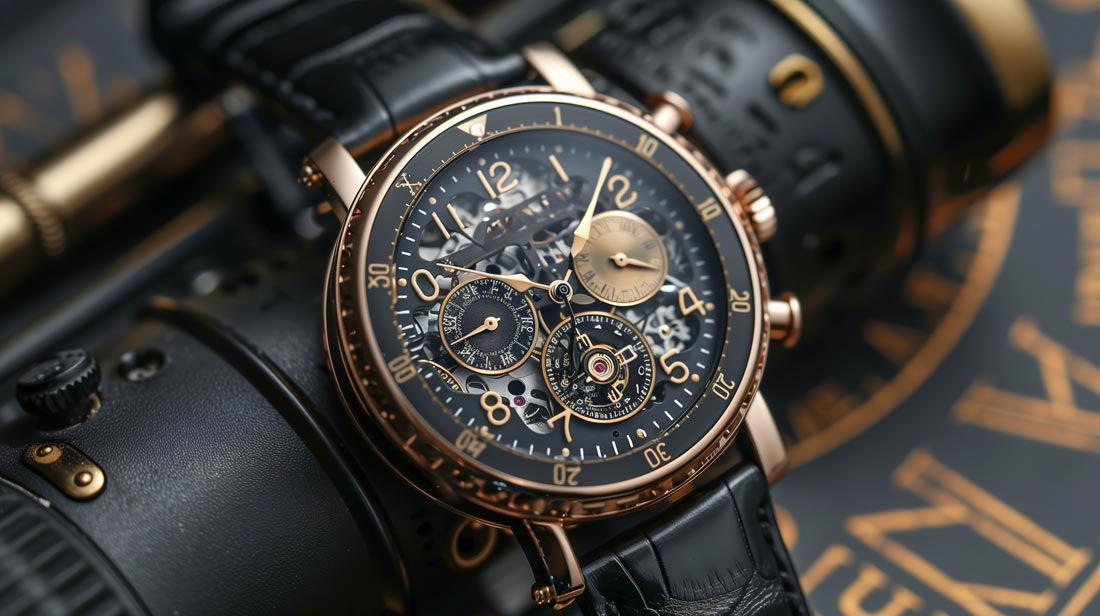
There is something slightly ironic about mechanical watches still attracting attention in a world where time is displayed on just about everything. Phones, cars, ovens, coffee makers… even a refrigerator can tell the time now.
And yet, a watch that needs to be wound by hand somehow still holds its ground.
That probably says more about the watch than it does about the clock on the microwave.
Vintage mechanical watches are not just about telling time. If accuracy alone were the goal, there are far easier ways to get there. What keeps people interested is everything happening underneath the dial… all the tiny moving parts working together without a single battery involved.
A mechanical watch is basically a controlled system of energy.
A spring is wound, energy is stored, and that energy is released in a regulated way through a series of gears and an escapement. It is not complicated just for the sake of being complicated… it is complicated because that is what it takes to measure time without electronics.
Watching that system work, even if it is hidden inside a case, is part of the appeal.
Vintage pieces take that one step further.
Each watch comes from a specific period, built with the tools, materials, and design choices available at that time. That means no two eras feel exactly the same. Case sizes change. Dial designs shift. Materials evolve.
Looking at a vintage watch is a little like looking at a snapshot of a different time… except this one still ticks.
Condition plays an interesting role in all of this.
In most things, wear and tear is something to avoid. With vintage watches, it becomes part of the story. A dial that has aged slightly, a case that shows signs of use… those details can add character instead of taking it away.
There is a line, of course. A watch still needs to function, and certain kinds of damage are not doing anyone any favors. But a little age tends to make a piece feel more authentic rather than less.
Originality matters too.
Collectors tend to look for watches that still have the parts they were born with. Original dials, hands, and movements carry more weight than replacements. Once pieces start getting swapped out, the connection to the watch’s history starts to blur.
That does not mean restored watches do not have a place… it just means there is a difference between preservation and replacement.
Scarcity adds another layer.
Some watches were produced in limited numbers. Others became rare simply because time reduced how many were left in good condition. Either way, finding certain pieces becomes part of the process.
And once something becomes harder to find, it naturally becomes more interesting.
There is also the matter of design.
Vintage watches have a look that stands apart from modern production. Proportions tend to be different. Details are often more subtle. There is a balance in many older designs that feels intentional without being overly complex.
They were built in a time when trends moved a little slower.
That slower pace shows up in the final product.
Then there is the interaction.
A mechanical watch does not run forever on its own. It needs attention. Winding it, setting it, occasionally servicing it… all part of the experience. That level of involvement creates a connection that does not exist with something that runs quietly in the background without ever being touched.
It is a small thing, but it makes a difference.
Maintenance is part of the reality.
Mechanical watches need to be serviced to keep running properly. Oils break down over time, parts wear, adjustments are needed. That process keeps the watch alive, but it also means ownership comes with a little responsibility.
Not a burden… just part of the deal.
From a collector’s perspective, there is also the research side.
Tracking down a specific model, understanding its history, learning how it was made… all of that becomes part of the experience. It is not just about owning the watch. It is about knowing what it is.
That knowledge tends to grow over time.
The market itself reflects that interest.
Auctions, private sales, collector groups… all contributing to how certain pieces are viewed and valued. Information is more accessible now than it has ever been, which means collectors have more tools to understand what they are looking at.
That also means fewer surprises… at least in theory.
At the end of the day, a vintage mechanical watch is more than a way to keep track of hours and minutes.
It is a piece of engineering that has managed to outlast the technology that replaced it. It is a design that reflects a specific time. It is a system that still works, often decades after it was built.
And it is one of the few things left that requires a little patience to appreciate.
In a world where everything moves fast, that alone is enough to keep people interested.
Even if the microwave clock is technically more accurate.+